

Quick Summary
- What is CBT for autism: Cognitive behavioral therapy adapted with visual tools, plain language, and behavioral practice to fit how autistic individuals think and communicate.
- Why it works differently: Standard CBT frequently misses the mark for autistic clients because the modifications to how therapy is delivered are what determine whether it actually helps.
- Who it's designed to help: CBT for autism targets the anxiety, OCD, depression, and emotional dysregulation that co-occur with autism — not the autism itself.
- What to expect: Treatment follows a predictable structure, runs longer than standard CBT, and includes between-session practice so skills transfer to real life.
- Care in Virginia: Compass Behavioral Health offers integrated psychiatric care and therapy to Virginia residents via telehealth, statewide.
You know your child better than anyone. You see how hard they work, how deeply they feel, and how much they want to connect with the world around them. And when anxiety, big emotions, or emotional dysregulation start getting in the way of that, finding the right support becomes your whole focus.
If you’re researching CBT for autism, you’re already doing something important. You’re looking for answers that are rooted in evidence, not guesswork.
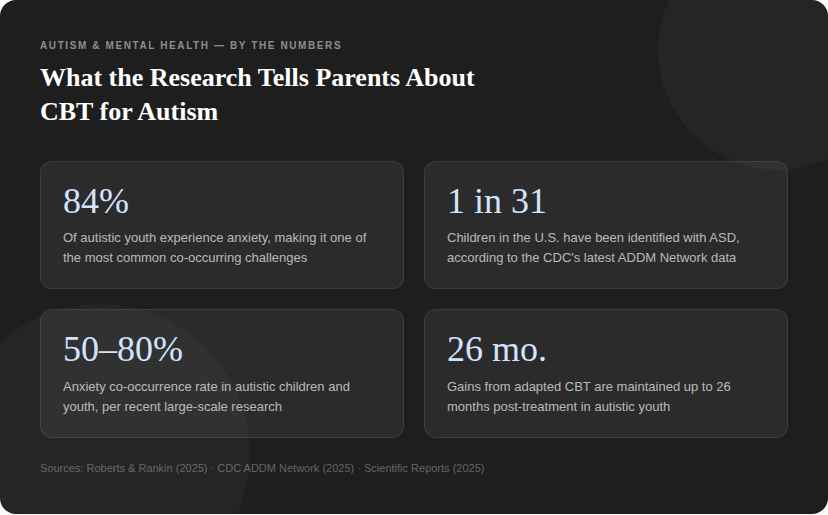
CBT for autism is one of the most researched therapy approaches available for addressing the anxiety, emotional dysregulation, and co-occurring mental health challenges that many autistic children navigate every day. 84% of autistic youth experience anxiety, and that adapted CBT produces real, lasting improvements, with gains maintained up to 26 months after treatment ends.
This post is here to help you understand what CBT therapy for autism actually involves, how it differs from standard therapy, and what getting started looks like for your family.
What Is CBT for Autism?
CBT, or cognitive behavioral therapy, is a structured, goal-focused form of therapy built around one core idea: the way you interpret a situation shapes how you feel about it, and how you feel influences what you do. By identifying unhelpful patterns in thought and behavior and learning to respond differently, people can develop better tools for managing what life throws at them.
CBT has decades of evidence behind it for anxiety, depression, OCD, and more. It’s practical, skill-focused, and time-limited by design.
Why Standard CBT Often Doesn’t Work for Autism
Standard CBT was built for neurotypical communication styles. It relies heavily on:
1. Abstract self-reflection and identifying cognitive distortions:
CBT traditionally asks clients to examine their own thought patterns from the inside. For many autistic individuals, that kind of introspection is genuinely difficult and can feel disconnected from how they actually experience the world.
2. Figurative language and open-ended conversation
Metaphors, analogies, and indirect questioning are standard therapeutic tools. For autistic clients who process language more literally, these create real communication barriers that standard CBT never addresses.
3. The assumption that clients can already name and describe their emotions
Many autistic individuals experience alexithymia, a genuine difficulty identifying and labeling emotional states. When therapy assumes that skill is already there, the whole model can break down before it starts.
For many autistic people, the result is sitting through CBT that feels disconnected from their actual experience, and leaving therapy believing it simply wasn’t for them. That’s not a personal failure. It’s a mismatch between the tool and the need.
What Makes CBT for Autism Different
CBT therapy for autism makes the structural changes that let the same evidence-based model actually work:
1. Concrete language in place of metaphors and abstract framing
Every concept is expressed directly and literally, so clients spend their energy on the actual work rather than on decoding what their therapist means.
2. Visual aids, structured worksheets, and diagrams
Abstract verbal processing is replaced or supplemented with visual tools that make concepts tangible and give clients something to reference between sessions.
3. Behavioral practice as the primary vehicle for building skills
Rather than analyzing thought patterns, clients learn by doing. Skills are built through structured, repeatable practice.
4. Explicit emotion recognition work built into the foundation of treatment
Before coping strategies can land, clients need tools for identifying what they’re actually feeling. Adapted CBT treats that as foundational, not assumed.
5. Predictable, consistent session structure
Knowing what to expect at each session reduces the cognitive load of therapy itself, so more of your child’s energy goes into the work.
When those adaptations are made, the research is clear: adapted CBT outperforms standard CBT for autistic individuals across multiple outcomes.
Exploring autism counseling options? The adaptation piece isn’t a detail. It’s what determines whether therapy will help.
Why So Many Autistic Individuals Need Mental Health Support
Autism spectrum disorder is a neurodevelopmental difference, not a mental health condition. But it frequently co-occurs with mental health conditions, and those conditions often go unaddressed for years.
According to the CDC, about 1 in 31 children in the United States has been identified with ASD. A recent large-scale study found that anxiety co-occurs in 50 to 80% of autistic children and youth. Depression, OCD, and emotional dysregulation also appear at significantly higher rates than in the general population.
What Are The Signs of Autism in a Child:
For families, the daily impact often looks like this:
- Anxiety that makes school transitions, social events, or schedule changes feel overwhelming
- Emotional outbursts or shutdowns that seem to come out of nowhere
- OCD-like behaviors that weren’t recognized as OCD because they looked like rigidity
- Depression that built up quietly and wasn’t connected to anything treatable
- Social avoidance that grows wider year after year
For autistic adults, it often looks different: the weight of long-term masking, anxiety that was mislabeled or dismissed for years, or a late diagnosis that reframes a lifetime of struggles without offering a clear path forward.
CBT for autism isn’t designed to treat the autism. It’s designed to treat the anxiety, OCD, depression, and emotional regulation challenges that so often accompany it, and that have their own names and their own evidence-based treatments.
For autistic individuals managing anxiety or OCD, getting those conditions treated specifically can genuinely change how much energy is left for everything else.
Why Cognitive Behavioral Therapy is Effective for Autism
If therapy hasn’t helped before, there’s often a reason. Adaptation has to be thorough, not surface-level. Here’s what it actually means to adapt CBT therapy for autism in clinical practice.
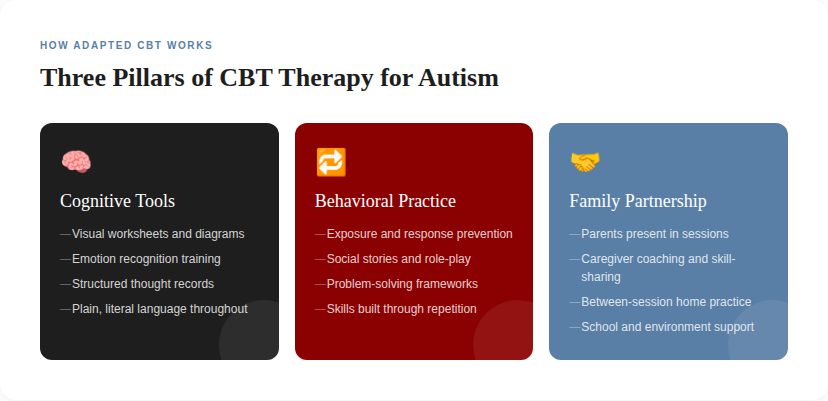
1. Plain, literal language.
Idioms and figurative expressions that feel natural in conversation can cause real confusion for autistic clients. Adapted CBT removes that barrier entirely.
2. Visual supports throughout
Worksheets, diagrams, emotion charts, and rating scales replace or supplement verbal processing. These tools also help clients remember and apply what they practiced in session.
3. Emotion recognition as foundational work
Many autistic individuals experience alexithymia, difficulty identifying and naming their own emotional states. Before coping strategies can work, clients need tools to recognize what they’re feeling in the first place.
4. Behavioral practice over abstract introspection
Rather than spending most of therapy analyzing thought patterns, adapted CBT emphasizes learning through doing: practicing skills in structured ways that build competency through repetition.
5. Active caregiver involvement.
For children especially, parents attend sessions, learn the skills alongside their child, and get coaching on how to reinforce coping strategies at home and school.
6. Longer, more flexible timelines
Standard CBT typically runs 12 to 16 sessions. Adapted CBT often extends beyond that to allow time for building foundational skills before moving into more complex work.
These modifications require real clinical skill. A therapist trained in CBT but without experience adapting it for autistic clients will often deliver a version of therapy that misses the mark.
Our providers at Compass have direct experience working with autistic individuals across presentations and ages.
CBT Techniques for Autism That Clinicians Use
The specific CBT techniques for autism your provider draws on will depend on your goals and what you’re addressing. But these are the tools that appear most consistently across both the research and clinical practice.
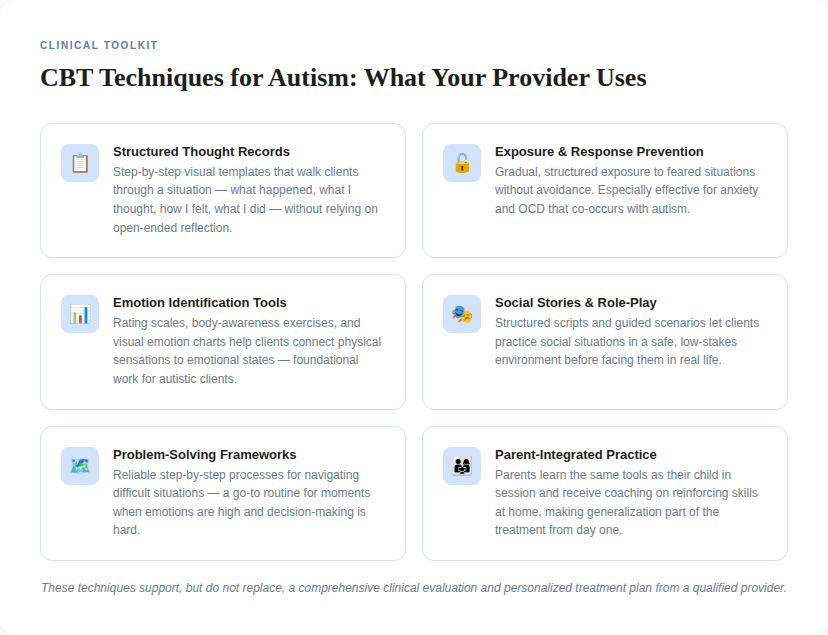
1. Structured Thought Records
Instead of open-ended journaling, clients work through situations on a step-by-step visual template: what happened, what I thought, how I felt, what I did. The structure makes the process accessible and concrete.
2. Exposure and Response Prevention (ERP)
For autistic individuals dealing with anxiety or OCD, ERP involves gradually and safely facing feared situations without engaging in avoidance. A recent cluster randomized trial found significant reductions in anxiety in autistic youth following a school-based CBT program using these principles. It’s one of the most evidence-supported tools in the toolkit, particularly for OCD that co-occurs with autism.
3. Emotion Identification Tools
Body-awareness exercises, rating scales, and visual emotion charts help clients connect physical sensations to emotional states. For many autistic clients, this work has to come first.
4. Social Stories and Role-Play
Practicing social situations in session with structured scripts and guided scenarios builds real skills and confidence before clients have to navigate those situations in actual life.
5. Problem-Solving Frameworks
Step-by-step structured approaches give clients a reliable process to fall back on when emotions are high and decision-making feels out of reach.
For autistic children also navigating developmental disorders or higher support needs, these techniques are adjusted further, with more behavioral scaffolding and tighter caregiver involvement built into the structure.
Who CBT for Autism Helps
For some families, autism is part of a more complex picture. If your child has also received an ADHD diagnosis — or if attention, impulsivity, and emotional regulation challenges are part of what you’re navigating alongside autism — that shapes how CBT is planned and delivered. Here’s where CBT may help along your journey:
CBT for Autistic Children
For autistic children, the evidence base is among the strongest in the field. A recent meta-analysis confirmed that CBT improved social skills in autistic children compared to control groups, with parents and teachers reporting measurable change.
Family involvement is the most important factor in making this work. In adapted CBT for children, parents:
- Participate in sessions directly
- Learn the same coping strategies their child is building
- Receive coaching on reinforcing skills at home and school
- Help their child practice between sessions so skills transfer to real life
Children who receive adapted CBT for autism regularly show gains in managing transitions and social anxiety, naming and regulating their emotions in the moment, using coping tools when overwhelmed, and building confidence in situations that previously felt impossible.
CBT for Autism and ADHD
The overlap between autism and ADHD is significant and well-documented. A recent study in JCPP Advances found that individuals with both autism and ADHD experience markedly higher rates of anxiety and depression than those with either condition alone.
CBT for autism and ADHD addresses where the two conditions overlap in practice:
- Emotional dysregulation and impulsivity
- Executive functioning challenges
- Difficulty building and maintaining routines
- Managing frustration before it escalates
ADHD treatment and autism support work best when they’re integrated rather than siloed. A provider who understands both can design a treatment plan that holds the full picture.
What to Expect When You Start CBT Therapy for Autism
One of the most common things parents tell us is that they wish someone had explained the process before they started. Therapy feels less daunting when you know what’s actually coming. Here’s an honest look at what the process looks like for autistic children and their families.

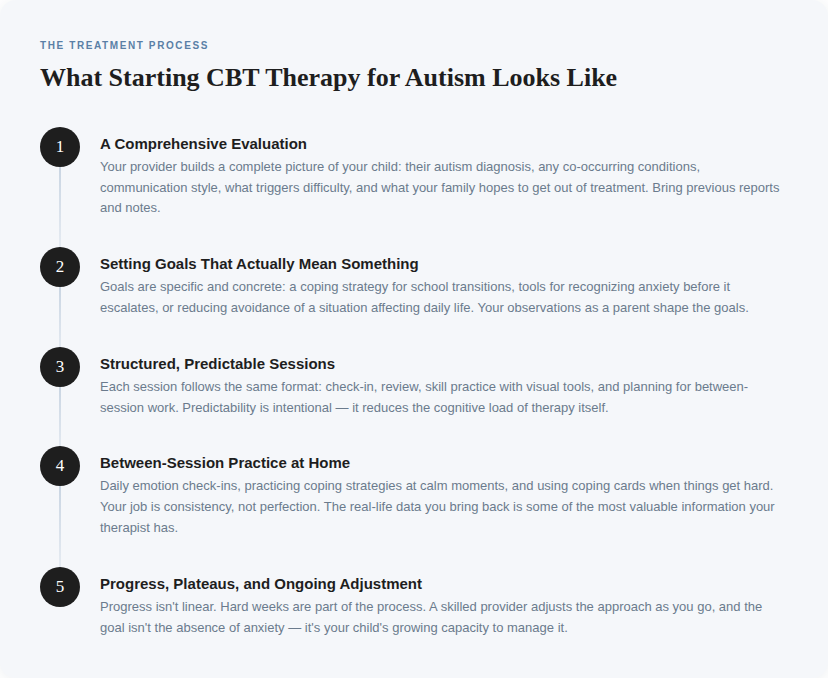
Step 1: A Comprehensive Evaluation
Before any CBT for autism begins, your provider will conduct a thorough intake evaluation. This isn’t a quick intake form. It’s a real conversation designed to understand your child as a whole person.
You can expect your provider to ask about:
- Your child’s autism diagnosis and any co-occurring diagnoses (anxiety, ADHD, OCD, etc.)
- Current medications and any previous therapy experiences
- Specific behaviors, triggers, or situations that are causing the most difficulty
- Your child’s communication style, sensory sensitivities, and what helps them feel safe
- What your family hopes to get out of treatment
Come prepared. Bring any previous diagnostic reports, school records, or notes on patterns you’ve noticed at home. The more context your provider has, the more targeted the treatment plan can be. Our patient resources page has guidance on what to bring and how to prepare for your first appointment.
Step 2: Setting Goals That Actually Mean Something
Once your provider has a full picture, you’ll work together to set goals for treatment. In adapted CBT for autism, goals are specific and concrete, not vague intentions.
Goals might look like:
- Building a coping strategy your child can use before school transitions
- Learning to identify the physical signs of anxiety before they escalate
- Reducing avoidance of a specific situation that’s affecting daily life
- Building an emotional vocabulary to replace behavioral responses
As a parent, your input matters here. You see your child in contexts the therapist never will. What happens at school pickup, at family dinners, during homework time: all of that shapes what meaningful progress looks like for your family. Goals can shift over time as your child builds skills and new challenges emerge.
Step 3: What Sessions Actually Look Like
One of the most valuable adaptations in CBT for autism is that sessions follow a predictable format. For autistic clients, knowing what to expect at each appointment reduces anxiety about therapy itself, freeing up more energy for the actual work.
A typical session might include:
- A brief check-in on how the week went and whether the between-session practice was manageable
- Review of any challenges or situations that came up since the last session
- Introduction or continued practice of a specific skill, using visual tools and structured activities
- Planning for what to practice before the next session
For children, parents are typically present for part of the session and receive a check-in at the end. This isn’t just a courtesy. It’s how you learn the same language and tools your child is building, so you can support the work at home.
Step 4: The Work That Happens Between Sessions
This is where a lot of parents are surprised. The most important part of CBT for autism often isn’t what happens in the therapy room. It’s what happens in the car on the way to school, at bedtime, or when a hard moment hits in the middle of the grocery store.
Between-session practice typically looks like:
- A simple daily emotion check-in using a visual scale your child helped create
- Practicing a breathing or grounding technique at a low-stress time of day so it’s available when things get hard
- Using a coping card your child made in session as a reference when anxiety spikes
- A brief parent debrief where you note what worked, what didn’t, and what to bring to the next session
You don’t need to be a therapist to support this work. Your job is consistency, not perfection. Celebrate effort over outcome, keep practice short, and bring your observations back to the provider. Those real-life data points are some of the most valuable information your therapist will have.
Step 5: Progress, Plateaus, and What ‘Working’ Actually Looks Like
Progress in CBT for autism is not a straight line. There will be sessions that feel like breakthroughs. There will be weeks that feel like regression. Both are part of the process, and a skilled provider will help you understand the difference between a genuine plateau and normal variation.
A few things to keep in mind as you go:
- Skills often get harder before they get easier. Your child learning to name their anxiety means they’re more aware of it, and that awareness can feel uncomfortable at first.
- Treatment for autism-related CBT typically runs well beyond 12 to 16 sessions. That’s not a sign that something is wrong. It reflects how much foundational work goes into making the skills real and lasting.
- Your provider will regularly review progress and adjust the approach. If something isn’t landing, that’s clinical information, not failure.
- The goal of treatment isn’t the absence of anxiety or difficulty. It’s building your child’s capacity to manage those things with more confidence and less distress.
When treatment is working, you’ll often notice it in small, everyday moments before you notice it in big ones. Your child asks to use a coping strategy instead of shutting down. They name what they’re feeling. They try the hard thing. Those moments matter.
Conclusion: Finding CBT Support for Autism in Virginia
Watching someone you love navigate anxiety or emotional challenges alongside an autism diagnosis is exhausting in a way that’s hard to fully put into words. For many families, years pass before anyone recognizes that what they’re dealing with isn’t just autism: it’s a co-occurring condition that has its own name, and its own treatment.
CBT for autism, done with the adaptations that make it actually work, is one of the strongest evidence-backed options available. Whether you’re a parent searching for something that will finally connect with your child, or an autistic adult ready for care that takes your experience seriously, you deserve a provider who understands the difference.
At Compass Behavioral Health, we serve Virginians navigating autism, anxiety, ADHD, and co-occurring conditions. Our approach is individualized because we know that one-size-fits-all doesn’t work, and because the people we work with have already spent too much time in systems that treated them that way.
If you’re in Virginia and looking for CBT therapy for autism that meets you where you are, we’re here.
Frequently Asked Questions About CBT for Autism
Yes, and when it’s adapted correctly, the results are meaningful. Adapted CBT for autism uses concrete language, visual supports, behavioral strategies, and emotion recognition training to meet autistic clients where they are. A recent systematic review found that adapted CBT produces gains in anxiety reduction that hold for up to 26 months after treatment ends. It isn’t a treatment for autism itself, but for the anxiety, OCD, depression, and emotional regulation challenges that frequently accompany it. Standard CBT without modification often misses the mark for autistic clients.
Yes, and children represent the strongest area of evidence for CBT and autism. Multiple randomized controlled trials show that adapted CBT meaningfully reduces anxiety and improves emotional regulation in autistic children and adolescents. Family involvement is central to how it works: parents participate in sessions, learn the same skills their child is building, and receive coaching on reinforcing coping strategies at home and school. Visual tools, social stories, in-session role-play, and literal language are all part of what makes the therapy work for kids.
The core model stays the same: thoughts, feelings, and behaviors are connected, and working with that connection builds better coping. What changes significantly is how the therapy is delivered. Adapted CBT for autism uses plain and literal language, visual aids and structured worksheets, explicit emotion recognition training, and a stronger emphasis on behavioral practice over abstract introspection. It also typically runs longer than a standard CBT course. These aren’t optional additions. They’re what determines whether the therapy actually works.
A standard CBT program runs 12 to 16 sessions, but adapted CBT for autism frequently extends well beyond that. The additional time allows for building foundational skills like emotion identification before moving into more complex coping strategies. For children, the timeline also accounts for caregiver coaching and skill generalization at home and school. Your provider will discuss a realistic timeline during the initial evaluation.
It can, particularly for the challenges that overlap between the two: emotional regulation, executive functioning, impulsivity, and difficulty with routines are all areas where adapted CBT has relevant tools. A thorough evaluation comes first. Understanding how both conditions are showing up for your specific child is what allows a provider to design treatment that addresses both, rather than defaulting to one.
If your child has an autism diagnosis and is dealing with persistent anxiety, emotional outbursts, social avoidance, OCD, or significant difficulty coping with change, adapted CBT is worth discussing with a provider. A psychiatric evaluation can help clarify whether CBT is the right approach, what other supports might work alongside it, and how to sequence treatment. Our services page outlines the full range of care available at Compass Behavioral Health across Virginia.
